A shared Texas Hold’em table for physical-game scorekeeping, synchronized scoring rooms, and server-dealt online play, with hand results and session reports.
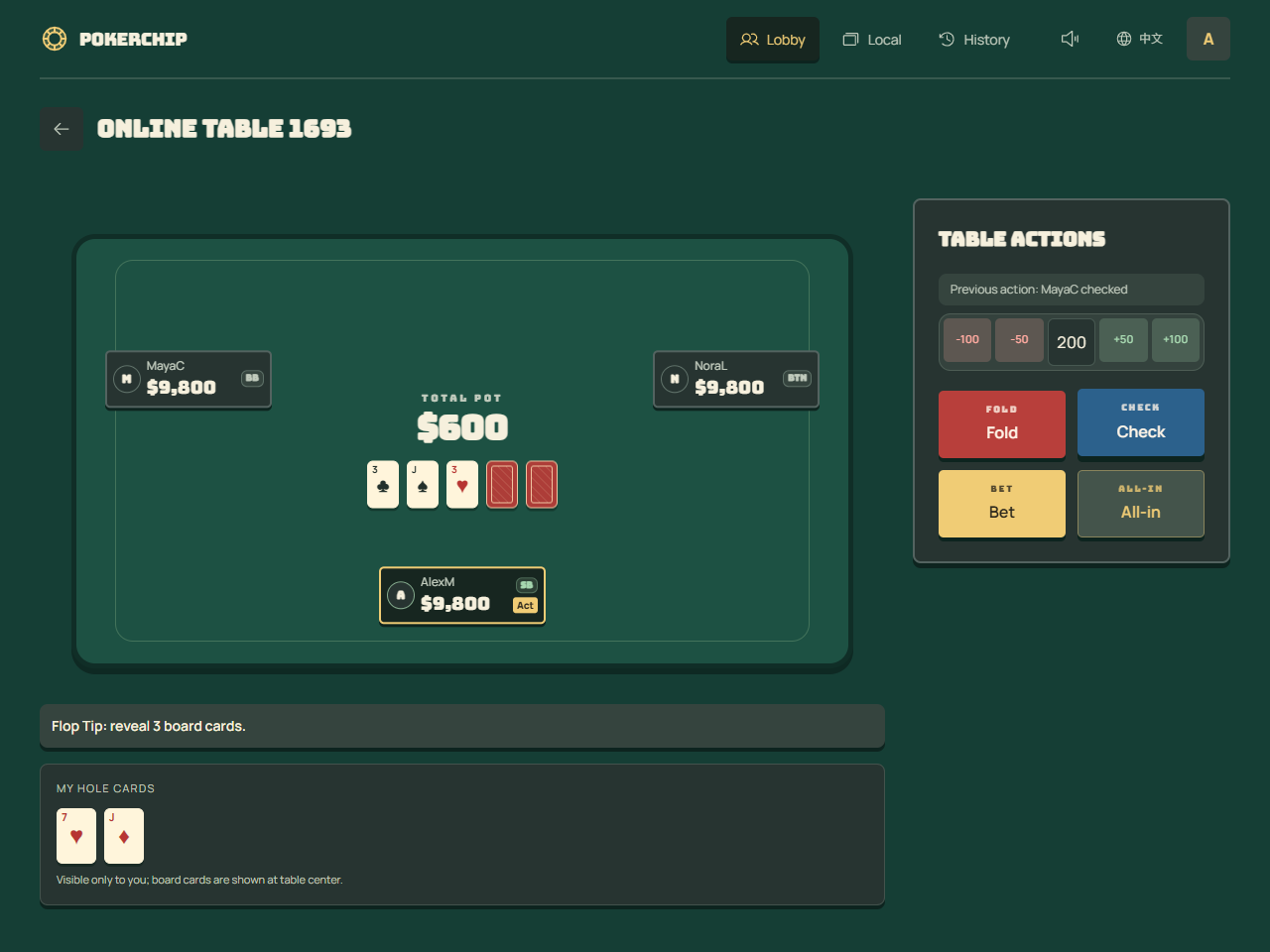
Repository demo capture: three-player online flop, private hole cards, pot, and the current player’s actions. Captured on 15 October 2026 in an isolated local demo environment.
01 / THE IDEA
One table. From first seat to final balance.
A poker session involves more than the current pot. Seats, action order, different contributions, split pots, and final balances must stay understandable to everyone at the table, across hands and devices.
Use one visual table for three distinct situations: an operator scores physical cards on one device, a host confirms physical-card winners in a synced room, or the server deals and evaluates online hands. Carry each hand forward into a session-level record.
02 / THE EXPERIENCE
From start to finish.
01
Choose a table
For quick match, choose 2–8 players and a tier with its starting stack and blinds. Private rooms instead use a four-digit room code.
02
Prepare together
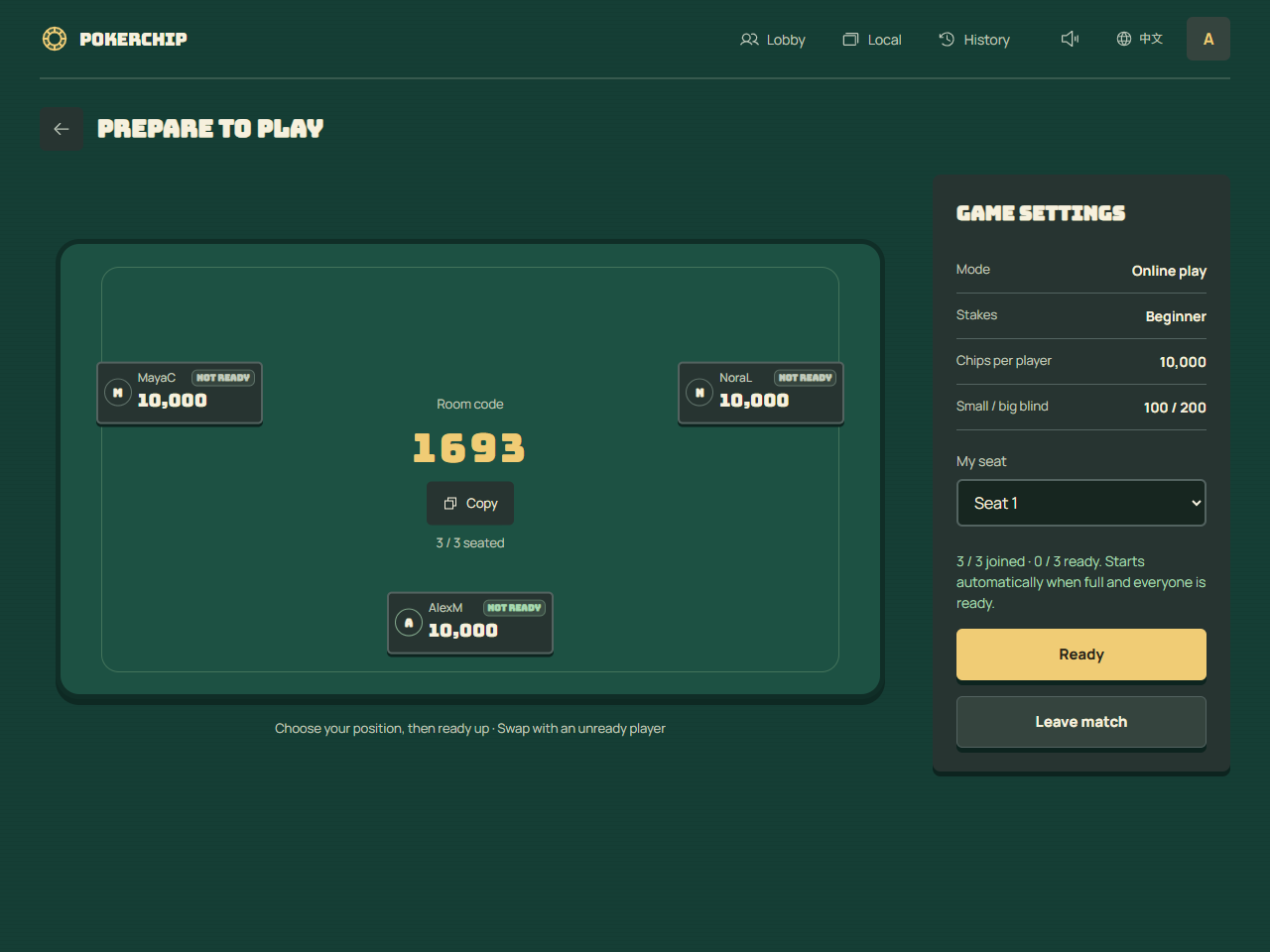
Quick match opens directly onto a preparation table. Pick a seat and ready up; dealing begins when the table is full and everyone is ready.
03
Play and inspect the result
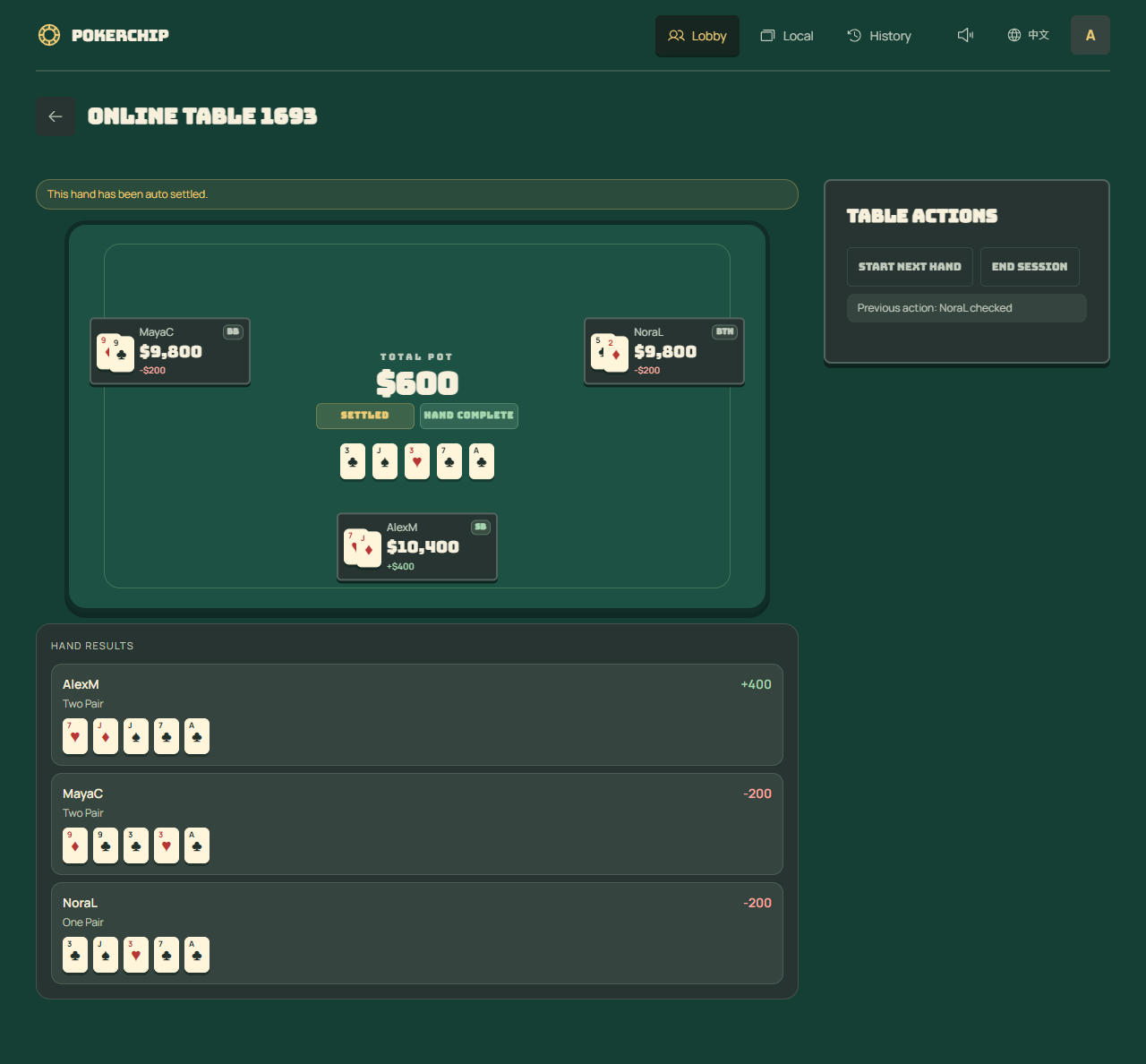
Act on your own turn with private hole cards. The server advances the board and settles the hand, showing rankings, best five cards, and net chip changes.
04
Continue or close the session
Eligible players agree before the next hand. Ending the session leads to final balances, virtual-chip transfer suggestions, and a hand-by-hand history.
03 / KEY DECISIONS
The details that shape it.
01
Three modes, one table language
Local scoring needs no account and keeps snapshots in the browser, with undo and restore controls. Synced scoring uses server state but retains human winner confirmation. Online play delegates dealing, legal actions, and hand evaluation to the server.
02
Waiting already feels like joining
The preparation screen reuses the playing table. Players can see who has arrived, change seats, and understand the readiness condition before play. Quick match requires a full, ready table; a private-room host controls when that room starts.
03
Results explain the chip movement
Deterministic rules compare five-card combinations and kickers, build side pots from contribution layers, and handle split pots and odd chips. Result cards connect the winning hand to each player’s net change. This is a rules engine, without AI judging.
04
The final hand is not the whole session
The report separates pots won from net gains and compares starting and ending stacks. Balanced, safe-integer net results produce virtual-chip transfer suggestions. Archived room sessions can be reopened for hand-by-hand review.
05
Mobile actions protect the table view
Portrait actions sit below the table; landscape controls move to the side. An in-app wager keypad avoids covering play with the system keyboard. Chip animation, sound controls, and reduced-motion support complete the feedback.
Preparation table: seating and readiness before dealing. Repository demo capture.Hand settlement: revealed cards, hand rankings, and net chip changes. This is a single-hand result, rather than a session report.
04 / IMPLEMENTATION
Under the surface.
The server owns room state and uses database row locks for important writes. Clients reject stale responses that cross a write, while preparation seats use heartbeat-renewed 30-second leases.
Persistent hosting supports Socket.IO. The Vercel deployment uses visible-room polling, targeting 250 ms in active hands and 750 ms during preparation or settlement; these are intervals, not measured latency guarantees.
Local snapshots and history stay in one browser; reloading does not preserve the in-memory undo stack. Room play requires a backend, database, and network.
Automatic hand evaluation is for server-dealt online games. Physical-card modes require a person to select winners; the app does not recognize physical cards.
The app records virtual chips and suggests chip transfers; it does not execute payments. Missing card data has a fallback settlement path, so abnormal states are not guaranteed to settle by hand strength.
How can a shared table make complex rules and collective decisions easy to follow?
Project source notes and current GitHub README, reviewed on 18 October 2026. Demo captures document a local build from 15 October; they do not verify the latest public deployment or unusual side-pot scenarios.
The question above is a direction for further exploration, rather than a reported research finding.